

CPS AI Blunder Exposes Serious Risks of AI in Legal Research
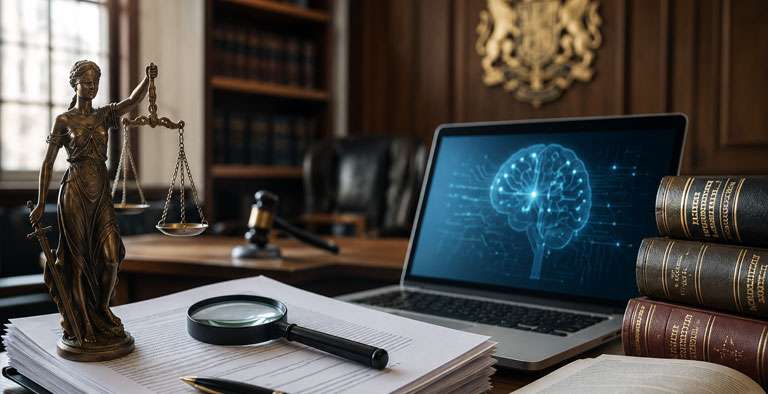
Artificial intelligence can analyse large volumes of information within seconds, but what happens when the authorities it produces simply do not exist.
The High Court has issued a powerful warning about the use of AI in legal research after written submissions filed on behalf of the Crown Prosecution Service contained references to two “non-existent” legal cases.
The mistake arose during extradition proceedings involving two individuals who were challenging decisions to return them to Romania to serve criminal sentences. Although the errors were identified before the hearing and did not affect the outcome, the incident demonstrates why AI-generated legal work must always be checked carefully by a qualified professional.
Mr Justice Sweeting accepted the CPS’s apology and found there had been no deliberate attempt to mislead the court. However, he stressed that artificial intelligence could create serious risks when used without appropriate human oversight.
Table of Contents
What Happened in the CPS AI Legal Research Case?
The issue arose in Tobosaru v Court of Law Craiova, Romania [2026] EWHC 1720 (Admin), an extradition appeal heard in the High Court.
The two appellants challenged decisions ordering their extradition to Romania, where they were required to serve sentences for offences committed there. The CPS opposed both appeals.
In documents forming part of the prosecution’s case, two legal authorities were cited in support of its submissions. However, Mr Justice Sweeting later confirmed that neither authority existed.
The same supposed authorities were repeated in another document before the problem was raised with the CPS ahead of a hearing in February 2026.
The CPS subsequently acknowledged that the citations were inaccurate, apologised to the court and began investigating how they had appeared in formal legal submissions. In correspondence sent in March, it explained that the false references were likely to have originated from the use of generative artificial intelligence.
Why Did AI Produce Non-Existent Legal Cases?
Generative AI systems produce responses by predicting plausible combinations of words based on patterns in their training data. They do not automatically verify every statement against an authoritative legal database.
An AI tool may therefore generate a case name, neutral citation or judicial quotation that appears convincing but is inaccurate or entirely invented. This is commonly described as an AI “hallucination”.
The risk is especially serious when using AI in legal research because a fabricated authority may look authentic. It might include realistic party names, a court abbreviation and a citation presented in the correct format.
Unless the authority is checked against an approved legal database or an official judgment, the person reviewing the document may fail to notice that the case is fictional.
This is why AI output cannot be treated as the equivalent of verified legal research. It may provide a starting point, but every case, quotation, statutory provision and procedural rule must be independently confirmed.
The CPS Said Human Error Was the Operative Cause
The CPS accepted that generative AI was likely to have been the immediate source of the inaccurate references. However, it argued that the critical failure was the reviewing lawyer’s failure to check the document properly before it was filed and served.
Mr Justice Sweeting summarised the CPS’s position by explaining that the “operative cause” was human error rather than the technology alone.
In other words, the AI tool may have generated the false authorities, but responsibility remained with the lawyer who approved the submissions.
The CPS emphasised that there was no deliberate attempt to deceive the court. It described the matter as an isolated incident caused by inadequate checking of written work.
This distinction is important. Legal professionals cannot avoid responsibility by blaming an AI system, an automated research tool or another person who assisted in preparing a document.
Solicitors, barristers and prosecutors remain professionally responsible for material submitted in their name.
CPS Reviewed 78 Other Cases Linked to the Lawyer
Following the discovery, the CPS conducted a full internal review.
According to the judgment, it examined 78 other cases connected with the same lawyer. The review identified no further concerns, leading the CPS to conclude that the risk of a similar problem having occurred elsewhere was low.
The prosecution authority also considered the lessons arising from the incident and the measures required to prevent a recurrence.
The CPS stated that it does not use artificial intelligence to make legal decisions or determine charging outcomes. It also confirmed that the incorrect authorities had no impact on the legal arguments or the court’s eventual judgment.
The review provides some reassurance, but the incident still raises important questions about how public bodies and legal practices control the use of AI-assisted tools.
Effective safeguards should include:
- A clear policy governing approved AI tools
- Mandatory verification of all legal citations
- Training on hallucinations and confidentiality risks
- Human review before documents are filed
- Records explaining how AI was used
- Escalation procedures when inaccuracies are discovered
Judge Warns About AI in Legal Research
Mr Justice Sweeting accepted the CPS’s apology and its assurance that nobody had attempted to mislead the court.
He also recognised that the errors were discovered before the appeal hearing. As a result, they did not affect the arguments advanced by the parties or the final decision.
Nevertheless, the judge considered the matter serious enough to address publicly in his judgment. He observed that it would be unrealistic to assume artificial intelligence would not be used increasingly in legal work.
He acknowledged that the technology may prove both necessary and beneficial. However, he warned that the episode demonstrated the dangers of using it without suitable oversight, particularly when conducting legal research.
The message is not that legal professionals must avoid AI completely. Instead, AI in legal research must be treated as an assistive tool rather than an authoritative source.
Could False Case Citations Affect a Court Decision?
In this case, the errors were detected before the hearing and did not influence the outcome.
The High Court dismissed the two extradition appeals on their substantive merits. The fictional authorities therefore played no part in the court’s reasoning.
In different circumstances, however, reliance on a false authority could have significant consequences. It could waste court time, increase costs, undermine a party’s case or cause the court to approach an issue on an incorrect legal basis.
Depending on the seriousness of the conduct, a lawyer could also face:
- Judicial criticism
- A costs order
- Referral to a professional regulator
- Disciplinary proceedings
- Damage to their professional reputation
- Further investigation into other cases
The High Court has previously made clear that legal professionals retain ultimate responsibility for their work and cannot outsource legal reasoning or research entirely to artificial intelligence. The rapidly growing number of reported hallucination incidents illustrates that this is an international issue rather than a purely theoretical risk.
What Does the Incident Mean for the Future of Legal AI?
Artificial intelligence is likely to become a normal part of legal practice. It can help organise documents, identify issues, summarise information and provide a starting point for research.
However, speed must not replace accuracy.
Lawyers using AI in legal research should verify every authority through reliable sources, including official court judgments, legislation databases and established legal research platforms.
They must also consider client confidentiality, data protection, privilege and whether sensitive information is being entered into an external system.
The CPS incident shows that even an apparently minor research mistake can become part of a reported High Court judgment. Once a document has been filed, responsibility rests with the legal professional and the organisation behind it.
Used responsibly, AI may improve efficiency and access to justice. Used without proper checks, it can introduce persuasive but entirely fictional material into serious legal proceedings.
Speak to Newgate Solicitors About a Criminal or Extradition Matter
Extradition and criminal proceedings can involve complex evidence, strict deadlines and serious consequences. Legal arguments must be based on accurate law and carefully verified authorities.
Newgate Solicitors provides clear, professional advice to individuals facing criminal investigations, prosecutions and related court proceedings.
Contact our experienced team today to discuss your circumstances and obtain advice tailored to your case.
Frequently Asked Questions
Did the CPS use fake cases in court documents?
Two authorities cited in CPS documents did not exist. The CPS accepted that the inaccurate references were likely to have originated from generative AI.
Did the CPS deliberately mislead the High Court?
No. The judge accepted the CPS’s assurance that there had been no deliberate attempt to mislead the court.
Did the incorrect cases affect the extradition appeal?
No. The errors were discovered before the hearing and did not affect the legal arguments or the court’s judgment.
What is an AI legal hallucination?
It occurs when an AI system generates false or misleading information, such as an invented case, quotation or legal citation.
Can solicitors use AI for legal research?
Yes, but all AI-generated information must be checked carefully against reliable and authoritative legal sources.
Who is responsible when AI creates a false citation?
The lawyer approving and submitting the document remains responsible for ensuring that its contents are accurate.
How many other cases did the CPS review?
The CPS reviewed 78 other cases linked to the lawyer involved and reported that it found no further concerns.
Does the CPS use AI to decide criminal charges?
The CPS said it does not use AI when making legal decisions or determining charging outcomes.
Can a lawyer be disciplined for filing invented cases?
Potentially. Serious failures may result in judicial criticism, costs consequences or referral to a professional regulator.
Is AI safe to use in legal proceedings?
It can be useful when properly controlled, but it should never replace professional judgment, independent research and human verification.
Related Posts

Powerful Lawsuit Claims Trump ICC Sanctions Violate Free Speech
Two US advocacy groups claim Trump’s ICC sanctions unlawfully restrict free speech and pro-Palestinian advocacy.…
The Hidden Danger of AI Legal Advice
Artificial intelligence tools are increasingly used for legal information, but relying on AI legal advice…
ChatGPT Confession That Exposes Hidden Privacy & Evidence Risks
A US college student allegedly confessed to vandalism via ChatGPT. This case exposes how AI…