

Anthony Littler Murder: Undercover Police Operation Leads to Historic Convictions
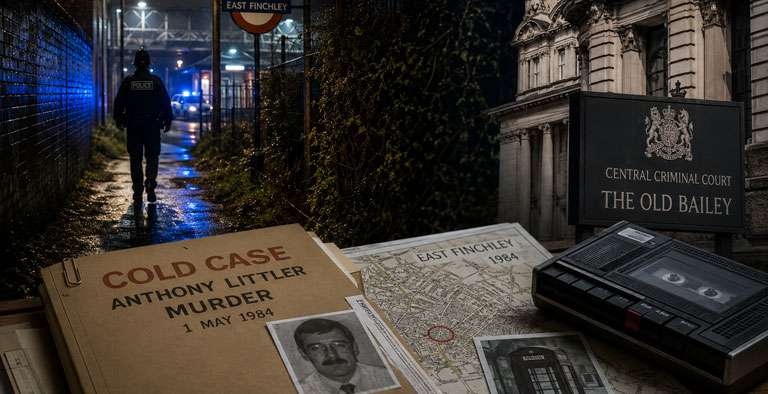
The Anthony Littler Murder case has concluded more than four decades after the civil servant was attacked near East Finchley station in 1984.
Brothers Michael Stewart and Anthony Stewart were convicted at the Old Bailey following a prosecution built around historic witness accounts, covert recordings, police interview evidence and an extensive undercover police operation.
The defendants were aged 15 and 18 at the time of the incident. Both received life sentences, with minimum terms of 10 years and 15 years respectively.
Newgate Solicitors was instructed in connection with the defence in this historic criminal case.
Table of Contents
What Happened in the Anthony Littler Murder Case?
Anthony Littler was a 45-year-old civil servant who lived in East Finchley, north London.
Shortly after midnight on 1 May 1984, he left East Finchley station and walked along a narrow footpath beside the railway line towards his home.
Within minutes, he had been attacked and suffered serious head injuries. He did not regain consciousness.
There were no known eyewitnesses to the assault, no CCTV footage and no forensic evidence identifying those responsible. Mr Littler’s cash, credit cards and personal possessions were reportedly still with him.
The original police investigation included house-to-house enquiries and television appeals, but no one was charged.
Why Did the Investigation Remain Unresolved?
The initial investigation closed in January 1985. The case was reviewed again in 1993 and between 2012 and 2015, but neither review resulted in a prosecution.
By the time detectives reconsidered the case, several difficulties had developed:
- Original exhibits could no longer be located.
- Some records and paperwork were missing.
- Potential witnesses had died.
- The area surrounding East Finchley had changed.
- No new DNA or fingerprint evidence was available.
Historic criminal cases can be difficult for both the prosecution and defence. Memories may become less reliable, documents can disappear and defendants may be required to answer allegations concerning events that took place decades earlier.
How the Anthony Littler Murder Investigation Was Reopened
A significant development came after information was provided to police during a family dispute.
The prosecution relied on accounts from individuals who said the Stewart brothers had spoken about the incident over the years.
Detectives then began rebuilding the original timeline. They reviewed historic witness statements, police enquiry forms, old railway timetables and maps showing East Finchley as it appeared in 1984.
A police search team also examined more than 200 crates in an attempt to find the missing exhibits. Although the material was not recovered, investigators believed the remaining accounts provided a basis for further enquiries.
Operation Snowpitch and Covert Recordings
In September 2023, the Metropolitan Police began Operation Snowpitch.
The covert investigation involved listening devices being placed in Michael Stewart’s home and vehicle. A device was also reportedly placed on Anthony Stewart’s vehicle.
Two undercover officers, known during the proceedings as “JJ” and “Anna”, separately developed relationships with Michael Stewart.
JJ initially approached him by discussing a broken lift in his block of flats. Over time, the relationship developed, and Michael reportedly spoke to the officer about the historic incident.
The prosecution relied on secretly recorded conversations in which Michael attributed responsibility to his brother and other individuals.
Covert evidence can form an important part of a criminal case, but it must be considered in context. Defence representatives may examine how the conversation began, whether remarks were encouraged and whether individual statements are capable of different interpretations.
Police Interview Evidence in the Anthony Littler Murder Trial
During a police interview in March 2024, Michael Stewart referred to being at the top of the alleyway and keeping watch.
The prosecution argued that this was significant because nobody had previously accused him of acting as a lookout.
The jury also heard evidence about an emergency telephone call made shortly after the assault. A young-sounding caller requested an ambulance for a bleeding man but ended the call without providing his identity or a precise location.
The prosecution alleged that Michael made the call after leaving the alleyway.
The defence was entitled to challenge the interpretation placed on both the police interview comment and the emergency call. As in every criminal trial, the prosecution remained responsible for proving its case beyond reasonable doubt.
Convictions and Sentencing
The jury at the Old Bailey convicted Michael Stewart and Anthony Stewart of murder.
Mrs Justice Cutts sentenced both men to life imprisonment. Michael Stewart received a minimum term of 10 years, while Anthony Stewart received a minimum term of 15 years.
A minimum term is the period that must normally be served before the Parole Board can consider release. It does not guarantee that a prisoner will be released when the minimum period expires.
The court was also required to consider the defendants’ ages at the time of the offence and their respective roles in the incident.
Legal Issues Raised by the Anthony Littler Murder Proceedings
The case demonstrates the complexity of defending historic allegations involving covert surveillance and evidence gathered over many years.
Important legal issues can include:
- Whether surveillance was lawfully authorised.
- Whether recordings were complete and reliable.
- Whether conversations were presented in context.
- Whether missing exhibits affected the fairness of the trial.
- Whether historic witness accounts remained reliable.
- Whether the defendants could properly answer allegations dating back decades.
The passage of time does not automatically prevent a prosecution. However, the court must still ensure that the defendant receives a fair trial.
Newgate Solicitors’ Role
Newgate Solicitors was instructed in connection with the defence.
The role of a criminal defence solicitor is to protect the client’s rights, examine the prosecution evidence, identify weaknesses and ensure that the case is conducted fairly.
This responsibility applies regardless of the seriousness of the allegation or the level of public interest.
Where a case involves undercover officers, historic witness evidence or covert recordings, specialist legal representation is particularly important.
Keywords used: Newgate Solicitors, defence solicitors, serious crime representation, covert evidence.
Speak to an Experienced Criminal Defence Solicitor
Anyone arrested, invited to a voluntary interview or contacted about a historic criminal allegation should seek legal advice before answering questions.
Newgate Solicitors provides confidential advice and representation at police stations and throughout Crown Court proceedings.
Contact Newgate Solicitors today to speak to an experienced criminal defence solicitor.
Frequently Asked Questions
What was Operation Snowpitch?
Operation Snowpitch was the undercover police investigation involving surveillance devices and covert officers.
When did the incident take place?
Anthony Littler was attacked shortly after midnight on 1 May 1984.
Where did the case take place?
The incident happened near East Finchley station in north London.
Was DNA evidence used?
The prosecution did not rely on newly discovered DNA evidence.
Can covert recordings be used in court?
Yes, provided they are lawfully obtained and considered admissible.
Can historic witness evidence be challenged?
Yes. The defence can question reliability, memory and inconsistencies.
What sentence did Michael Stewart receive?
He received life imprisonment with a minimum term of 10 years.
What sentence did Anthony Stewart receive?
He received life imprisonment with a minimum term of 15 years.
Is there a time limit for prosecuting murder?
There is no general statutory time limit for prosecuting murder in England and Wales.
Should I have a solicitor during a voluntary interview?
Yes. A voluntary interview is conducted under caution, and answers may be used as evidence.
Related Posts

Fish Conspiracy – £20m Cocaine Gang Sentenced
The Fish Conspiracy saw four men jailed for a combined 71.5 years after smuggling £20m…
Shocking Met Police Officer Sacked After BBC Panorama Investigation
A Metropolitan Police officer has been dismissed without notice and barred from policing after a…

Powerful CPS Asset Recovery Strategy
The CPS has announced a tougher strategy to target illegal assets earlier in serious organised…